
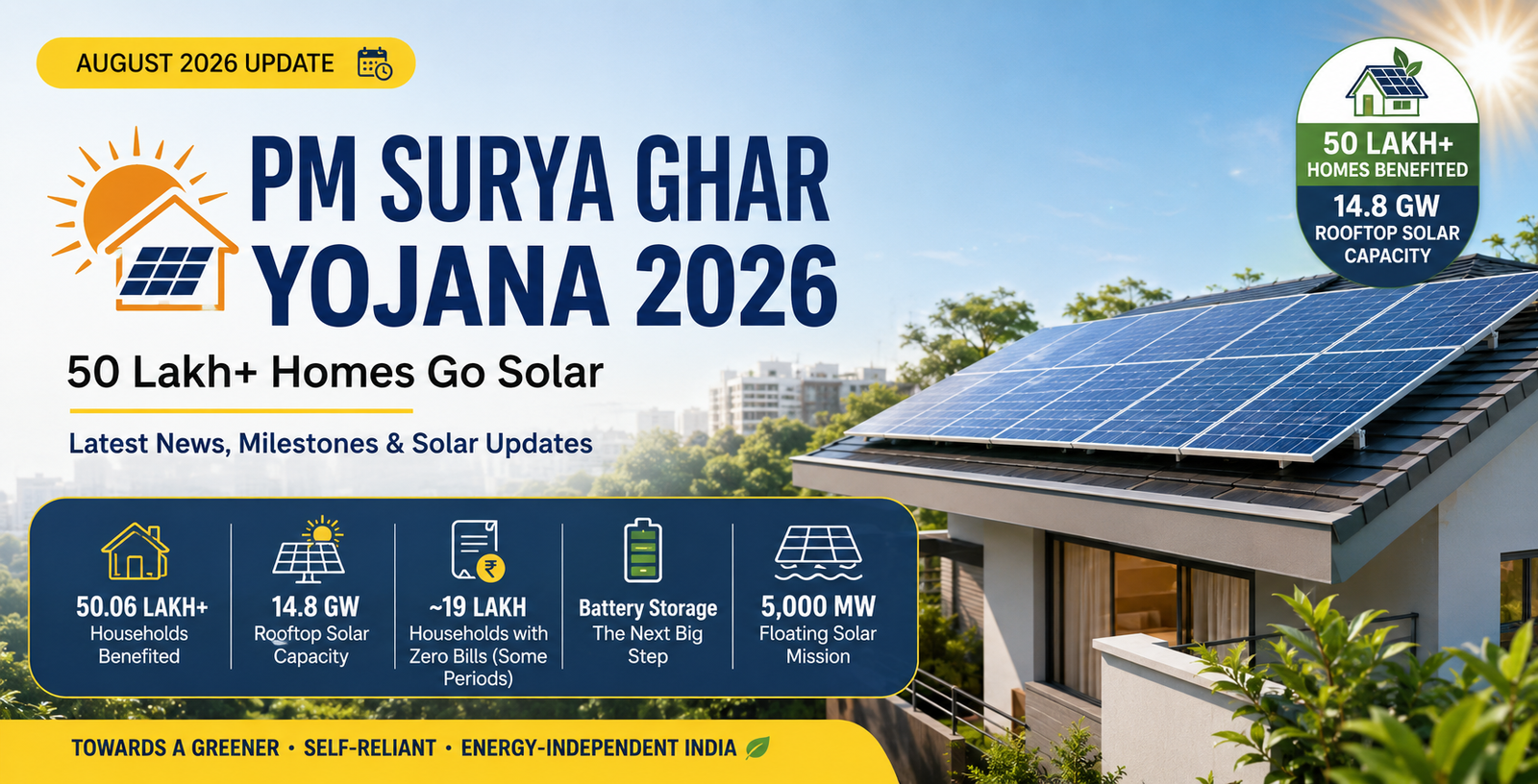
PM Surya Ghar Yojana 2026: 50 Lakh+ Homes Go Solar as India Accelerates Rooftop Solar Adoption
India’s rooftop solar revolution has entered a new phase in 2026. The PM Surya Ghar: Muft Bijli Yojana has crossed a major milestone, with more than 50 lakh households benefiting from rooftop solar installations across the country.
Launched in February 2024, the scheme was designed to help households install rooftop solar systems, reduce electricity bills and increase India’s clean-energy capacity. By August 2026, its implementation has accelerated significantly, making residential solar one of the country’s fastest-growing renewable-energy segments.
PM Surya Ghar Yojana Crosses 50 Lakh Household Milestone
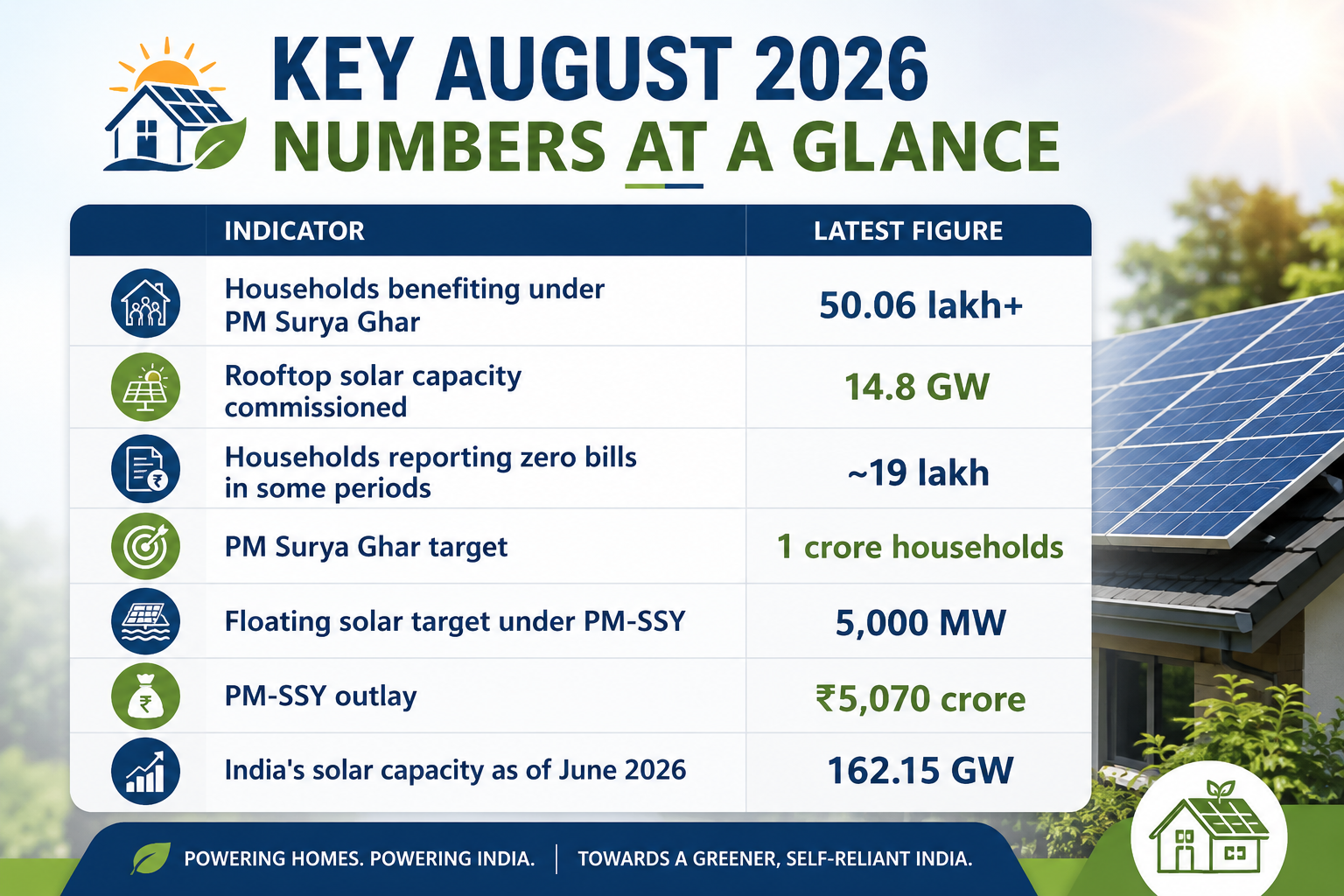
According to the Government of India, more than 50.06 lakh households had benefited from rooftop solar under PM Surya Ghar by early August 2026.
The programme has achieved this milestone in just over two years. For comparison, only around 7.94 lakh rooftop solar installations were recorded during the preceding ten years.
The government says approximately 14.8 GW of rooftop solar capacity has been commissioned under the programme, while nearly 19 lakh households have reported zero electricity bills for at least some billing periods, depending on their electricity consumption and solar generation.
This rapid growth shows how rooftop solar is moving from being a niche investment to a mainstream household energy solution.
July 2026 Records Highest-Ever Monthly Installations
One of the biggest developments in 2026 has been the sharp increase in installation speed.
Government data indicates that July 2026 recorded the highest-ever monthly rooftop solar installations under PM Surya Ghar. Installation rates reportedly crossed 16,000 systems per day, compared with around 5,000 installations per day in October 2025.
This acceleration is important because the scheme has a target of reaching 1 crore households by FY 2026–27.
With the programme already crossing 50 lakh households, the government is now looking at ways to maintain this momentum.
What Subsidy Is Available Under PM Surya Ghar?
The scheme provides Central Financial Assistance to eligible residential consumers installing rooftop solar.
The government’s July 2026 update also highlighted measures intended to make rooftop solar more affordable, including:
- Higher central assistance for the first 2 kW of rooftop solar capacity.
- Collateral-free loans through nationalised banks.
- Concessional financing linked to the repo rate.
- Support for RESCO and Utility-Led Aggregation (ULA) models.
As of July 22, 2026, nearly 39.72 lakh rooftop solar systems had been installed, benefiting more than 48 lakh households under the programme.
Why Are More Indian Homes Choosing Solar?
The increasing adoption of rooftop solar isn’t just about government subsidy.
1. Lower Electricity Bills
A properly sized rooftop solar system can significantly reduce electricity purchased from the grid. Depending on consumption, system size, sunlight availability and applicable net-metering arrangements, some households can bring their electricity bills close to zero during certain billing periods.
2. Protection Against Rising Power Costs
Solar allows households to generate a portion of their own electricity rather than depending entirely on grid power.
Once the system is installed, sunlight becomes the primary energy source, helping households reduce their exposure to future electricity tariff increases.
3. Long-Term Investment
Solar panels generally have a long operating life. Although installation requires an upfront investment, the combination of government assistance, electricity savings and financing options can improve the economics of rooftop solar.
4. Cleaner Energy
Every additional rooftop solar installation contributes to India’s transition towards renewable energy and reduces dependence on fossil-fuel-based electricity generation.
What's New in India's Solar Sector in August 2026?
PM Surya Ghar isn’t the only major solar development this month.
India’s broader solar sector is also expanding into energy storage and floating solar.
New Floating Solar Push: PM Surya Sarovar Yojana
In July 2026, the government approved the Pradhan Mantri Surya Sarovar Yojana (PM-SSY).
The programme aims to develop 5,000 MW of floating solar photovoltaic projects supported by energy-storage systems.
The scheme has an outlay of ₹5,070 crore and is planned for implementation from FY 2026–27 to FY 2030–31.
The projects will use reservoirs and suitable inland water bodies, helping generate solar power without requiring large areas of additional land. The government estimates that the programme could reduce around 10 million tonnes of CO₂ emissions annually once implemented.
This is an important development because India’s solar story is no longer limited to conventional ground-mounted and rooftop installations.
Battery Storage Could Be the Next Big Step
Another important discussion happening in August 2026 is the integration of battery energy storage systems (BESS) with rooftop solar.
Industry stakeholders are reportedly pushing for battery storage to become part of the next phase of PM Surya Ghar.
Why does this matter?
Solar generation is highest during the day, while household electricity consumption often continues into the evening. Batteries can store excess solar electricity during the day and make it available later.
This could make rooftop solar systems more useful even after sunset and potentially reduce pressure on the electricity grid.
The Ministry of New and Renewable Energy has been consulting industry representatives, experts, vendors and distribution companies regarding the next phase of the rooftop solar programme.
Solar Manufacturing Is Also Getting More Attention
India’s solar growth is increasingly being supported by domestic manufacturing.
The Ministry of New and Renewable Energy continues to update its Approved List of Models and Manufacturers (ALMM) for solar PV modules and cells.
In August 2026, MNRE published the 9th revision of ALMM List-II for solar PV cells, dated August 21, 2026.
For consumers, installers and businesses, this highlights an important point: choosing compliant and approved equipment is becoming increasingly important as India’s rooftop solar market expands.
What Does This Mean for Homeowners in 2026?
For Indian homeowners considering rooftop solar, 2026 could be an interesting time to evaluate installation.
The combination of:
Government subsidy + easier financing + falling technology costs + higher electricity awareness + increasing installation capacity
is helping make rooftop solar more accessible.
However, homeowners should not choose a system purely on the basis of subsidy.
Before installation, it is important to evaluate:
- Monthly electricity consumption
- Available rooftop area
- Roof orientation and shading
- Appropriate solar system capacity
- Local DISCOM regulations
- Net-metering provisions
- Panel and inverter quality
- Installer experience
- Warranty and after-sales service
- Expected annual solar generation
A correctly designed system can make a much bigger difference than simply installing the largest possible system.
The Road Ahead for PM Surya Ghar
The current PM Surya Ghar programme is targeting 1 crore households by FY 2026–27, and the government is already considering what the next phase could look like.
Possible areas of focus include:
Battery storage: Combining rooftop solar with batteries.
Rural expansion: Making solar more accessible to households outside major cities.
Innovative financing: Making installations easier for households that cannot afford the upfront cost.
Domestic manufacturing: Strengthening India’s solar supply chain.
Smarter rooftop systems: Greater use of digital monitoring and generation data.
MNRE has also issued August 2026 guidelines concerning inverter-level generation data and storage for rooftop solar systems, indicating a greater focus on monitoring and digitalisation of rooftop installations.
Conclusion
The solar market in India is entering a significant growth period.
The 50 lakh+ household milestone under PM Surya Ghar demonstrates that rooftop solar is rapidly becoming part of India’s mainstream residential energy landscape. At the same time, new initiatives around floating solar, battery storage, domestic manufacturing and smarter monitoring suggest that the next stage of India’s solar growth could be considerably more technology-driven.
For homeowners, the message is simple: solar is no longer just an alternative source of electricity—it is becoming an important part of India’s everyday energy infrastructure.
With the government aiming for 1 crore households under PM Surya Ghar, the coming months could be crucial for India’s rooftop solar industry.
Source: Government of India / Ministry of New and Renewable Energy / Press Information Bureau; August 2026 updates.